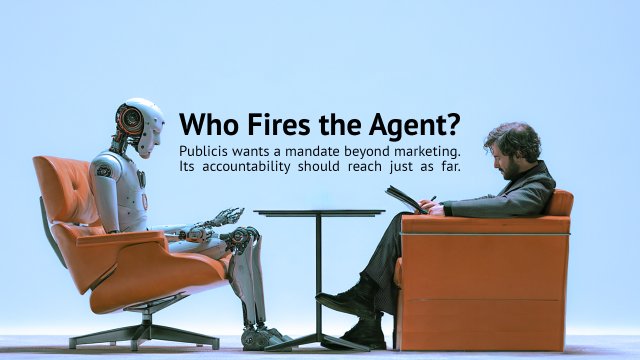

Publicis wants a mandate beyond marketing. Its accountability should reach just as far.
A senior marketer recently described a holdco relationship to Digiday that sounds like a success story. The deal has run for several years. The team likes the agency. Then the holdco's chief client officer grew closer to the company's C-suite, and something shifted. When the internal media buying team raises a complaint now, it struggles to get a hearing. It is no longer the agency's main sponsor inside the business.
Nothing in that story requires bad intent. The relationship simply moved upstairs, and the people closest to the work lost the ability to push back. That is the scenario I would keep in mind while listening to Arthur Sadoun.
Past the CMO
The Publicis CEO said this month that he pitches directly to CEOs. According to him, they are increasingly involved because they are passionate about AI and need to understand it well enough to make the right calls. Digiday's reporting was skeptical, and with reason. When a chief executive looks for outside counsel, the shortlist still tends to start with Accenture and Deloitte, whose boardroom relationships go back decades. Agencies built their business on the CMO and the next brief.
But the door is opening. Sadoun said Publicis Sapient helped land two of the year's biggest accounts without a pitch. PepsiCo's CEO, Ramon Laguarta, used an investor appearance to champion moving the company's global media account to Publicis, describing the partnership as an important capability. Digiday noted that he talked about Publicis less like a vendor and more like an asset PepsiCo had acquired. That is exactly the conversation Sadoun wants to have.
On October 22, Publicis gave that conversation a product. Scott Hagedorn became the first CEO of Marcel, the group's agentic platform, with Sam Levine Archer as chief strategy officer. Both roles are new, and both executives keep their existing jobs. Their mandate covers expansion into creator marketing, sports and live experiences, and brand visibility in AI-generated answers.
The ambition reaches well beyond marketing. When Publicis announced its $2.2 billion acquisition of the data collaboration platform LiveRamp in May, its lead example was a bank. A wealth management agent would combine tokenized customer data from the bank's retail, credit card and wealth businesses with partner data from merchants, payment networks and travel providers, and then cross-sell faster across lines of business.
No marketing brief can authorize that. Three business units have to agree on what data the agent may use and who signs off when it acts.
Transformation work pays well when it arrives. It also stalls easily. Publicis's own third-quarter release says its Technology practice, which includes Sapient, declined in the low single digits globally because clients turned cautious about capex-intensive transformation projects. The U.S. business is growing again, and Publicis expects the whole practice back to growth in the fourth quarter. A seat in the boardroom still doesn't protect a transformation budget from a nervous CFO.
What Marcel actually sells
"Anyone can build an agent," Hagedorn said. He is right, and it is the most honest line in the announcement.
Publicis's answer is that its people turn their expertise into agentic skills, thousands of them by now, connected to the group's proprietary identity graph. Sapient, Epsilon and Lotame supply the plumbing that links a client's enterprise and consumer intelligence to execution across channels. According to Adweek, Marcel already builds agents for more than 90 clients.
I take the argument seriously. A general-purpose chatbot can produce a recommendation, but it can't act inside a specific business. Someone has to know that business and have access to its systems. Publicis is offering to be that someone, and the knowledge it builds survives the end of a project instead of being reconstructed for the next brief.
That is also the problem. The more of a client's operating knowledge lives in Publicis-built skills, the more the client depends on Publicis to keep it. A pilot should be judged against a result the client can check, such as new customer growth that both sides agree would not have happened anyway. The number of agents deployed proves nothing.
The lock was never the model
Publicis says Marcel routes each task to the best-suited model, so no client is tied to a single LLM. It also says clients keep ownership and control of their data.
Fine. But the LLM was never the lock. The lock is the configured agent: the skills Publicis staff wrote, the instructions, the evaluation logic, and the connection to an identity graph the client does not own. Switching models inside Marcel tells you nothing about whether you can leave Marcel. Owning your customer records says nothing about your rights to the Publicis data that made the agent useful in the first place.
Before I approved a broad deployment, I would want to see a handover. Give another provider only what the client is entitled to take, and see whether it can rebuild a working agent. An exported data file won't pass that test. What made the agent reliable were its instructions and the methods used to evaluate it, and those are usually the parts nobody thought to put in the contract.
Pricing needs the same scrutiny. Digiday points to the questions CEOs are likely to ask: what the data costs, which technology fees are buried in bundled deals, and how principal media works, where the holdco buys inventory itself and resells it at a margin the client may never see. Integration makes those questions harder to answer, not easier. If one group designs the agent, supplies the identity data, recommends the media and sells you the inventory, you need to know which hat it is wearing on each line of the invoice.
What the FTC protected, and what it didn't
LiveRamp turns all of this into a live question. Publicis has described Marcel as the platform that would activate the co-created data across clients' enterprise functions.
On October 19, the FTC voted 2-0 to accept a proposed consent agreement for public comment. Its complaint alleged the deal could let Publicis push customers of rival agencies to switch, degrade services those rivals rely on, and use their competitively sensitive data to pressure them. It is a merger case under Section 7 of the Clayton Act, about competition in media agency services and audience data services. As of October 28, the order is still pending. Publicis says it proactively proposed the commitments and still expects to close before year-end.
The safeguards cover LiveRamp's U.S. business for five years. Standalone products must remain available on nondiscriminatory terms, and LiveRamp may not require customers to buy Publicis services to use them. Independent audits run every six months for the first two years after closing, then annually.
The firewall is the part that should interest anyone who thinks about AI. Publicis may not use LiveRamp customer data to develop, train, or improve its own products unless the customer expressly authorizes it. And LiveRamp may not make pricing, support or roadmap access depend on whether a customer grants that authorization. A regulator wrote a training clause into an advertising merger order. That sentence deserves attention.
But read the scope. The clause covers data held by LiveRamp. Whatever a client feeds into Marcel directly sits outside the order. That is governed by the client's own contract with Publicis, and the FTC wrote none of it.
This is the gap I keep coming back to in AI governance. The protections exist on paper for one pipe. The agent runs on several.
Two more limits matter. The order expressly allows Publicis to build new integrated LiveRamp and Publicis products and to choose which customers get them. Continued access to standalone LiveRamp does not guarantee access to an integrated product once you move your account elsewhere. And "elsewhere" is getting narrower. WPP has indicated it is winding down its agencies' use of LiveRamp, and Omnicom moved up its planned exit because of the deal. The order requires interoperability, but it cannot make your next agency stay on LiveRamp.
Who can say stop?
In an agentic setup, that team is often the first to see an agent get something wrong. If its complaints now have to travel up to a C-suite that owns the relationship, the agent keeps running while the escalation is in transit. The policy documents will say there is human oversight. What matters is whether the humans closest to the work still have the authority to use it.
So test the failure, not the demo. Before Marcel spreads across the business, run a bad recommendation through it on purpose and watch what happens. Can the marketing team see why the agent made the call, and can it stop the action without asking permission from someone two levels up?
The CMO should write those powers into the deal at the moment the CEO signs the wider mandate. After that, the client's leverage only goes down.